
Dashboards and reports that make you a better business owner
We’re a Google Looker (Data) Studio agency that can help
As a business owner you’re tasked with making countless decisions on a daily basis. Up until now you’ve managed most, if not all, of your marketing yourself. You’re spending valuable resources, including your own time and mental energy, on marketing analytics — and you’re not even sure how to use the information.
As your business has grown, so have your marketing efforts and with each new funnel comes another set of analytics. You know what your ad spend is and you’ve calculated your ROAS, but whenever you take a deep dive into the data the waters only seem to get murkier. It’s like you’re swimming in the ocean, but you can’t make it past the breakers.
You’re resourceful, but you’re also exhausted. You’re too close to the problem and both you and your business would benefit from an objective point of view you can trust.

Instead of sifting through the onslaught of information on individual platforms — most of which offer a one-size fits all approach to marketing analytics — wouldn’t it be nice to have a tailor-made dashboard that showed you only what you need to know when you need to know it? To feel confident in your decisions? To make more money?
To know that, if business should suddenly fall off, you could look to the numbers to tell you what went wrong? Stop treading water and make the decision to take your marketing to the next level with measurement marketing. We start with an in-depth audit of your current marketing efforts and reporting tools. Then we diagnose the problem.
We start with an in-depth audit of your current marketing efforts and reporting tools. Then we diagnose the problem.
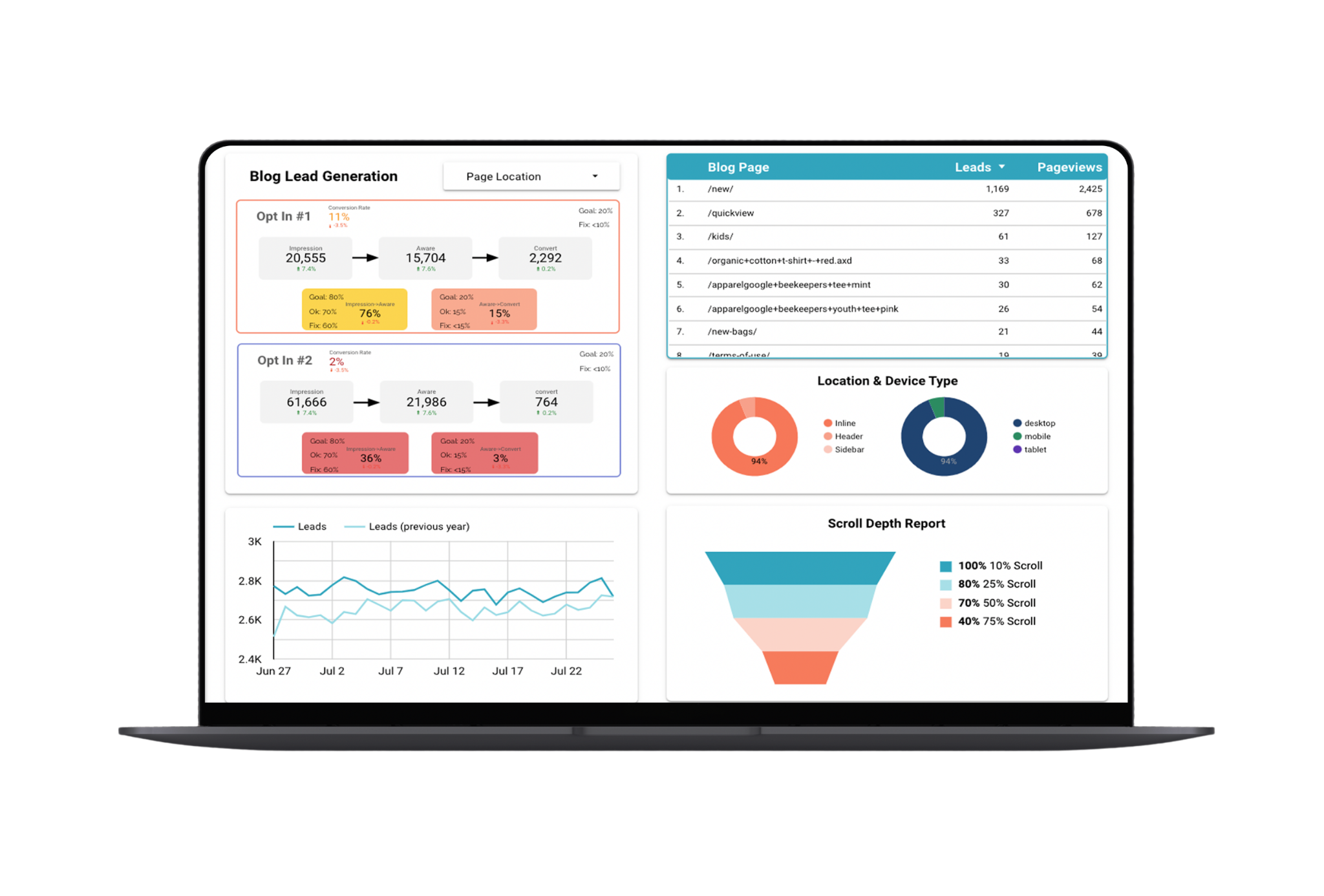
Next, we build custom, interactive dashboards in Google Looker Studio (formerly Google Data Studio) — complete with benchmarks that reflect your goals — and make the information easy to interpret and act on.
Once your marketing dashboards are built, we begin the forecasting and optimization process. The information we gain here will give new meaning to the term “you don’t know what you don’t know” (get ready to geek out on analytics with us).
From here on out, your marketing game plan also serves as a projection for your earnings — we can’t wait to show you how it’s possible.

Measurement marketing leaders are four times as likely to exceed business goals, increase market share, and increase revenue.
Need some Google Data Studio Help? If you’re interested in working with us on your dashboard, please contact us today.




Measurement marketing involves the strategic use of data analytics to assess and optimize marketing performance. By collecting and analyzing data from various marketing channels, businesses can gain insights into customer behavior, campaign effectiveness, and ROI. This approach allows marketers to refine their advertising strategies, leading to more targeted and effective ad placements. At Martin Marketing Inc., we specialize in leveraging advanced analytics to drive ad performance, ensuring that every marketing dollar is maximized for optimal returns.
Data-driven decision making is crucial because it provides empirical evidence for evaluating the success of marketing efforts. It moves beyond guesswork and intuition, offering concrete insights that guide strategic adjustments. By utilizing data, marketers can identify which ads resonate with their audience, leading to increased engagement and conversion rates. At Martin Marketing Inc., we empower businesses by providing comprehensive data analysis, helping them make informed decisions that significantly enhance ad performance.
Measurement marketing improves targeting by analyzing demographic, geographic, and psychographic data to identify the most responsive audience segments. This allows marketers to tailor ads to specific consumer needs and preferences, increasing the likelihood of conversions. At Martin Marketing Inc., we harness sophisticated targeting tools and techniques to refine audience segmentation, ensuring that ads reach the right people at the right time, thus optimizing ad spend and boosting performance.
Effective measurement marketing relies on a variety of tools such as Google Analytics, CRM systems, and custom dashboards. These tools collect data across multiple touchpoints, offering a holistic view of the customer journey. Techniques like A/B testing and multi-touch attribution are also critical, as they allow marketers to pinpoint which elements of a campaign are most effective. Martin Marketing Inc. provides businesses with tailored solutions, including advanced analytics platforms that streamline data collection and interpretation, driving superior ad performance.
Measurement marketing plays a pivotal role in budget allocation by identifying the most profitable channels and campaigns. By understanding which strategies yield the highest ROI, businesses can allocate resources more effectively, investing in high-performing areas while scaling back less effective ones. This approach not only enhances ad performance but also ensures a more efficient use of marketing budgets. Martin Marketing Inc. assists clients in optimizing their budget allocation and budget pacing through precise data analysis and actionable insights.
Yes, measurement marketing can help predict future advertising trends by analyzing current and historical data to identify patterns and shifts in consumer behaviour. This predictive capability allows marketers to stay ahead of the curve, adapting strategies proactively to meet emerging trends.
Measurement marketing enhances the creative process by providing insights into what resonates with audiences, informing content creation and design decisions. Data-driven feedback allows creatives to refine their messaging and visuals to better align with consumer preferences.
Conversion tracking is a method used to monitor and analyze the actions users take after interacting with your digital ads. It helps businesses understand which campaigns are driving desired outcomes, such as sales or sign-ups, and adjust strategies accordingly.
Conversion tracking is crucial because it provides data-driven insights into campaign performance. By understanding which marketing efforts lead to conversions, the marketing platforms such as Meta and Google can optimize their budget and strategy to improve the volume and cost per conversion.
Conversion tracking typically involves placing a small piece of code, known as a pixel or tag, on your website. This code records user interactions and reports back to your analytics platform, allowing you to see which ads are most effective in driving conversions. We often implement these scripts via Google Tag Manager to have more control over the order and timing of when the scripts fire.
Most major advertising platforms like Google Ads, Facebook Ads, Pinterest Ads and LinkedIn Ads support conversion tracking. Each platform provides its own tools and instructions for setting up and managing conversion tracking.
To set up conversion tracking, you need to create a conversion action in your advertising platform, then install the corresponding tracking code on your website or via Google Tag Manager. Ensure it’s placed on the pages where conversions occur, like a thank you or purchase confirmation page.
Key metrics to track with conversion tracking include conversion rate, cost per conversion, and the total number of conversions. If you have an eCommerce business, you would measure your return on ad spend (ROAS). These metrics help you understand the effectiveness and efficiency of your digital campaigns.
Yes, by identifying which campaigns and strategies yield the highest number of conversions at the lowest cost, you can allocate your ad spend more effectively. This optimization leads to better returns on investment.
Common challenges include incorrect code placement, privacy regulations affecting data collection, and discrepancies between different analytics platforms. Addressing these issues requires technical knowledge and strategic adjustments.
Privacy regulations like GDPR and CCPA impose restrictions on how user data is collected and used. It’s important to ensure compliance by obtaining user consent and providing transparent data usage policies.
Some platforms offer automated tools to track conversions, though initial setup and periodic reviews are necessary to maintain accuracy. Automation can save time and reduce errors in data collection.
Most of the clients we have worked with have required manual conversion tracking set up.
While conversion tracking focuses on capturing data about specific user actions, attribution assigns credit to various touchpoints in the customer journey that lead to conversions. Understanding both concepts can enhance your marketing strategy.